Gonçalo Marques · São Paulo
AI technology strategy for the real world.
For small and mid-sized companies that need to decide and execute on AI technology, from strategic analysis to the finished artifact.
01 · The opportunity
AI has already reached operations. The judgment for using it is still fragile.
Why the mid-sized company uses AI with no rule for deciding where it pays off, and no suitable source of support. The figures below show the same picture at both ends of the size range.
65%
of small businesses in Brazil already use AI, mostly text tools such as ChatGPT, Gemini and Copilot
74.3%
cite high cost as the main barrier to advanced digital technologies
60.6%
cite the lack of qualified staff, the barrier that has grown the most since 2022
What the mid-sized company has today, and why it is not enough
Large consultancies
Built for large accounts
Pyramid-shaped teams, months-long programs and fees sized for large corporations. The smallest project these firms take on is already bigger than the mid-sized company needs, or can afford.
AI tool vendors
They sell the tool, not the decision
They deliver the tool; rarely the decision on whether to use AI at all, where and how. The recommendation tends to start from what the vendor has to sell, not from the business problem.
Everyone with their own tool
Effort without direction
Employees adopt AI on their own, with no guidance from the company. The risk is spending without return or exposing data without noticing.
The empty space: senior decisions for mid-sized companies
GM Digital Bunker™
Senior strategy through to the finished artifact, with no team pyramid
Pure-strategy consultancies
Decision and plan, no construction
Tool vendors and builders
AI tool vendors, agencies and developers
Integrators and large consultancies
Multi-year programs for large corporations and government
Judgment before the tool.
Senior decisions, executed with AI, through to the finished artifact.
02 · The proposal
From diagnosis to the finished artifact
Diagnosis
Understand the business, the operation and where AI actually helps – and where it gets in the way.
Decision
Clear judgment for choosing priorities and tools, with no ties to vendors.
Artifact
Technical document, prototype, application or material for the team, ready to use.
The engagement ends in something usable, in the format in which it will be used.
No pyramid. With delivery.
Whoever diagnoses is whoever delivers: a senior who decides, with AI in production.
03 · Services
What the company can hire
04 · The proof
A real case, the published method and external evidence

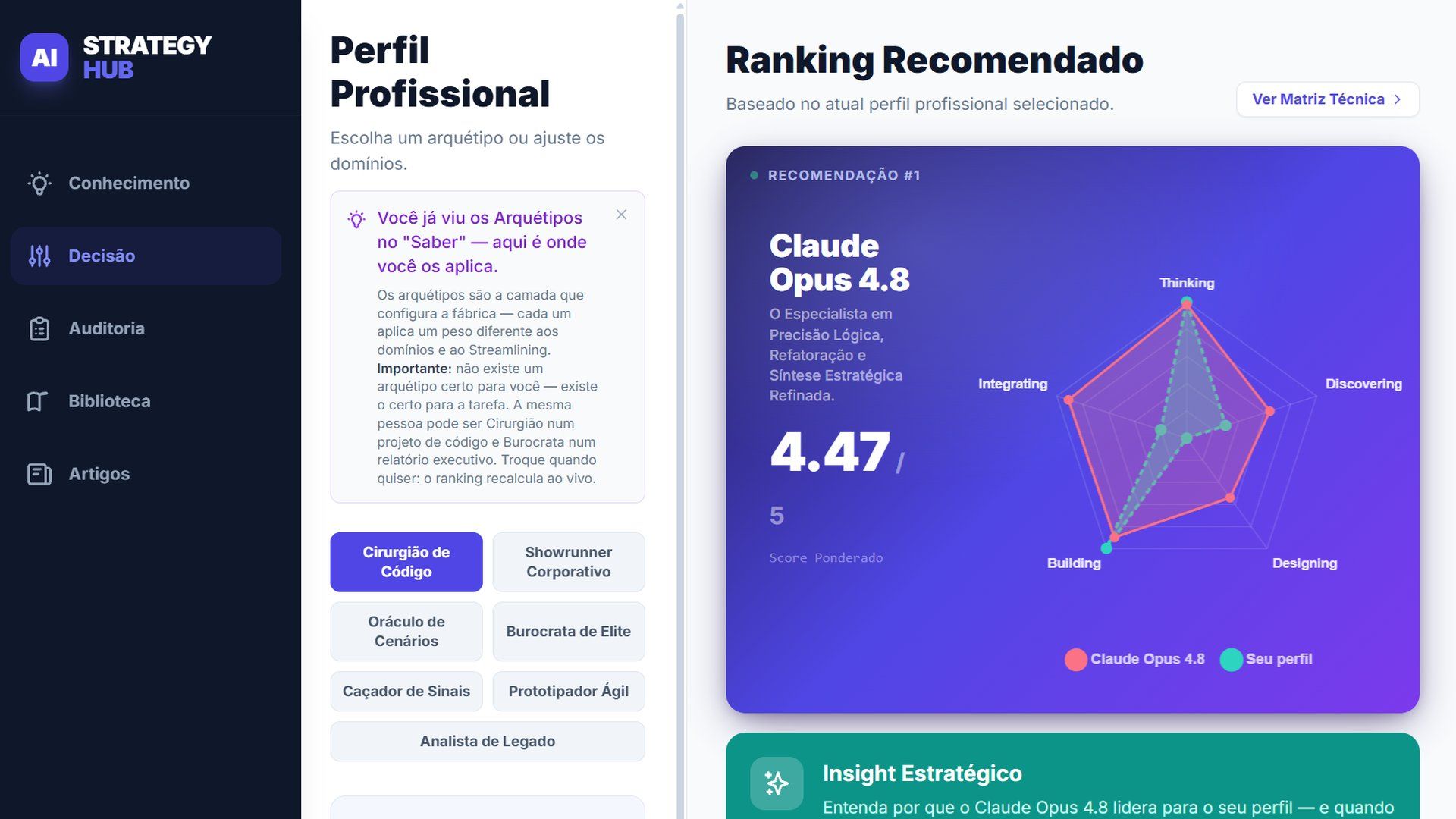
The articles on the method are in Publications
AI amplifies consulting work, when you know where to use it
+12.2%
tasks completed
+25.1%
speed of execution
+40%
assessed quality
−19
percentage points of accuracy on a task beyond AI's reach
The gain depends on knowing when AI helps and when it gets in the way. That is the question that names the method: when it's better with AI.
When is it better with AI?
Answering that question, case by case, is the work.
05 · The fit and the next step
A practice designed for companies without an executive dedicated exclusively to technology
- Size
- Mid-sized company (annual revenue of R$ 4.8 million to R$ 300 million) and growing small company
- Technology
- No dedicated technology director (CIO or CTO); lean, outsourced or operational IT
- Decision-maker
- CEO, partner or area director, who buys business results
- Moment
- AI not yet adopted or already used by the team on its own, with no shared rule for deciding where and when to invest
- Expectation
- A well-founded decision and something usable at the end of the project
What GM Digital Bunker does not do
24-hour operations
Round-the-clock operations or monitoring of large IT environments call for another kind of supplier.
Tool resale
No commercial ties to vendors: the recommendation starts from the business problem.
Technology unrelated to AI
The practice works where artificial intelligence is the subject or is in the product.
Third-party platforms
Deploying, configuring and maintaining third-party software is the vendor's responsibility.
Technical training on tools
Training on each tool is the responsibility of its vendor.
Managing large engineering teams
Productivity metrics for development teams call for another kind of supplier.